Re-cover or Replace: Is Your Chair or Sofa Frame Worth Saving?
The fabric is the easy part to change, so the real question is what's hiding underneath it.
October 20, 2026 · 4 min read
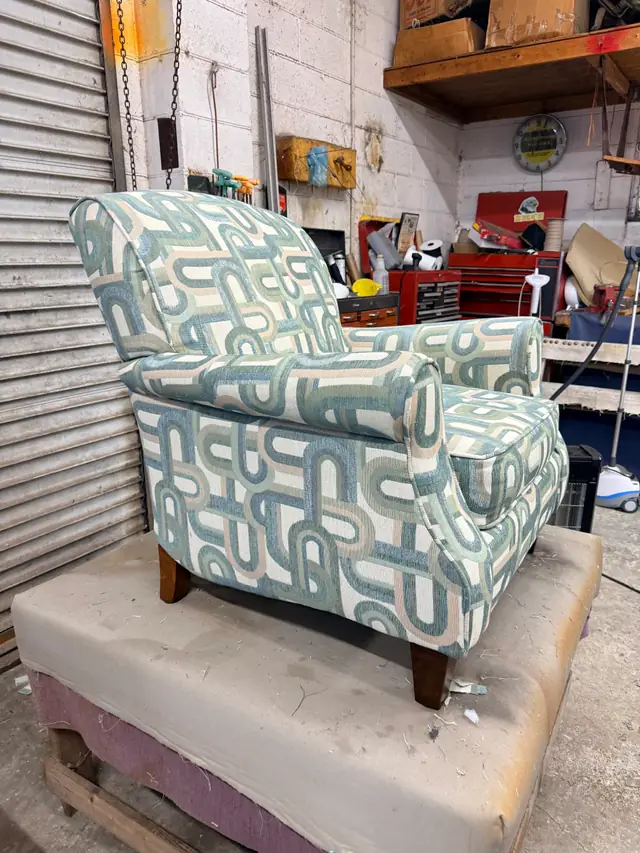
Most people who carry a tired chair into a showroom are asking one thing: is it worth saving? The fabric tells you very little. Fabric wears, fades and stains on every piece eventually, and replacing it is the easy part of our work. What decides the answer is the part you can't see, and a few checks at home will tell you most of it before you call. Here's how we look at a chair, sofa or dining set when it comes through the door.
Start with the frame
A good frame is the reason to re-cover anything. Turn the piece over or tip it back and look at the joints. Solid hardwood with corner blocks, dowels and glue lines that are still tight is what you want. Older furniture, the kind built decades ago, often has heavier frames than much of what is sold today, which is why a thirty year old chair can be a better candidate than a new one. Grab each arm and the back and try to rock them. A frame that moves, creaks or shows joints opening can usually be re-glued and braced. A frame that's cracked through the main rails or split along the grain is a different conversation. Staples doing the work of joinery, or thin particleboard parts, are signs of a piece built to be replaced rather than repaired.
Press, bounce and listen
Next, sit on it the way you normally would, then sit on each corner. A seat that sags in the middle, bottoms out against the frame or leans to one side has lost its support underneath. On many sofas and chairs that support is a set of springs or a band of webbing stretched across the frame. Webbing that's gone slack and springs that have come loose from their ties are common in older furniture, and both can be repaired or replaced during a re-cover. Listen as well. Squeaks and clicks usually point to a loose joint or a spring rubbing on the frame, which is much easier to cure with the cover off than with it on.
A quick check before you call
Ten minutes in the living room will give you most of what we'd want to know.
- Tip the piece and look at the joints for gaps, cracks or loose dowels.
- Rock the arms and back to see whether the frame flexes.
- Sit on each corner and in the center to find sagging or uneven support.
- Press the cushions and note whether the foam springs back or stays dented.
- Take two photos, one of the whole piece and one of the underside, to bring with you.
Foam and padding wear out first
Even a sound frame usually needs fresh padding. Foam breaks down with age, heat and use, and it does it quietly. Cushions that look fine can be flat underneath the cover, and a seat that has lost its fill feels hard on the way down and gives no support. Because the cover has to come off anyway, a re-cover is the natural time to renew the foam and wrapping so the finished piece sits and looks the way a new one would. In humid weather, old padding can also hold a musty smell that no amount of cleaning will remove, which is another reason to start over inside rather than only changing the outside.
When replacing is the better call
We'd rather tell you the truth than take on a piece that won't last. A frame that's cracked through the main rails, furniture held together mostly with staples and thin board, or a piece you've never liked sitting in are all good reasons to put your money toward something new. The same goes for a design that no longer fits the room. Re-covering gives you a new surface, but it can't change the shape. If the arms are too high, the seat is too deep or the back is too low, new fabric won't fix that. A good test is to ask yourself whether you'd buy this exact shape again if you saw it on a showroom floor today. If the answer is yes, it's usually worth the work.
What a re-cover involves
When a piece is worth saving, the work follows a steady order. The old cover comes off, which also shows us what's really underneath. The frame is repaired and re-glued where needed, springs or webbing are fixed, and the padding is replaced. Then the new fabric is cut, sewn and fitted, with the pattern lined up across the seat, back and arms. Choosing the fabric is half the fun, and our showroom has a large selection with sample books you can hold up beside your rug or your paint. We also offer decorator service if you want help pulling a room together. All of our workmanship is guaranteed.
If you're on the fence about a chair, sofa or dining set, bring it by the showroom on International Speedway Blvd in DeLand, or bring photos of the frame and the underside. You can also call 386-734-1809 for a free estimate, and we'll tell you plainly whether it's worth saving.
Hunt's Upholstery & Interiors, 386-734-1809
Call 386-734-1809More articles
Choosing Upholstery Fabric for a Florida Home
A fabric that looks perfect under shop lights has to survive afternoon sun, damp summers and your family.
Boat Seats in Florida Sun: Re-cover, Re-foam or Replace
Most boat seats fail in a predictable order, and knowing the order tells you what to fix.